





Game or gamble? Telegram tests new game function with emojis and virtual currency
 •
8 Jan 2026 •
Reading time: 2 minutes
•
8 Jan 2026 •
Reading time: 2 minutes
It is simple, fast, and emoji-driven. Telegram is quietly testing its own dice game with virtual money. But experts are holding their breath: how long will this remain outside regulatory oversight?
Available only to a small test group
An experimental game option has recently been hidden in the Android beta of Telegram: Emoji Stake. Players can set a stake, press a button, and immediately roll a digital die. The result appears alongside those of other participants. Whoever builds a streak sees it grow—until it resets after three turns or a change in stake.
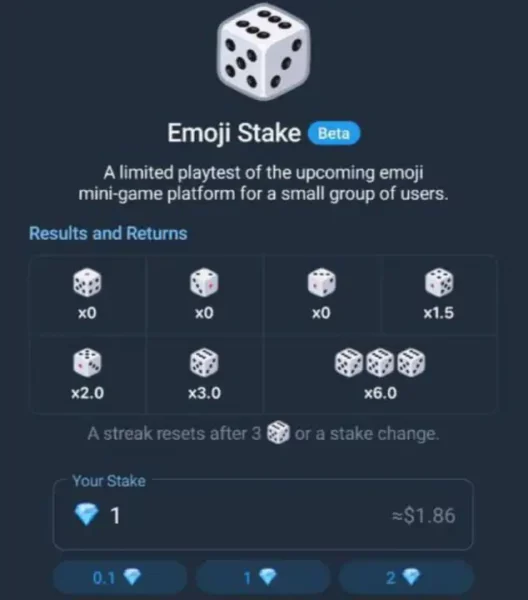
At first glance, it is a simple gimmick, an innocent game. But behind the scenes, there is close monitoring of how this develops. No official launch has been announced yet, and only a limited number of users can currently test the function.
Regulation lurking in the background
The test comes at a time when the US is cracking down increasingly hard on so-called sweepstakes games. These are games that appear free but still use a system with virtual coins or dual currencies. In states like Maine, Florida, and Tennessee, such structures have since been banned or heavily restricted.
Telegram seems to be aware of that risk. For now, there is no real money in the system, and the stakes are purely virtual. But lawmakers in Indiana, among others, are working on proposals that aim to bring this type of simulation under gambling legislation as well.
Durov’s interest in games is no secret
Telegram founder Pavel Durov has been flirting with interactive games within his app for some time. In November 2025, he even referred to a mini-game about a French prison and ‘shady characters’. That nod indicates that the company wants to be not just a chat app, but also entertainment and perhaps even competition.
According to Telegram Info, Emoji Stake is still far from a broad release. Yet it already makes clear that the line between chat, play, and (possibly) gambling is becoming thinner. And that raises questions. Not just for users, but especially for regulators.