




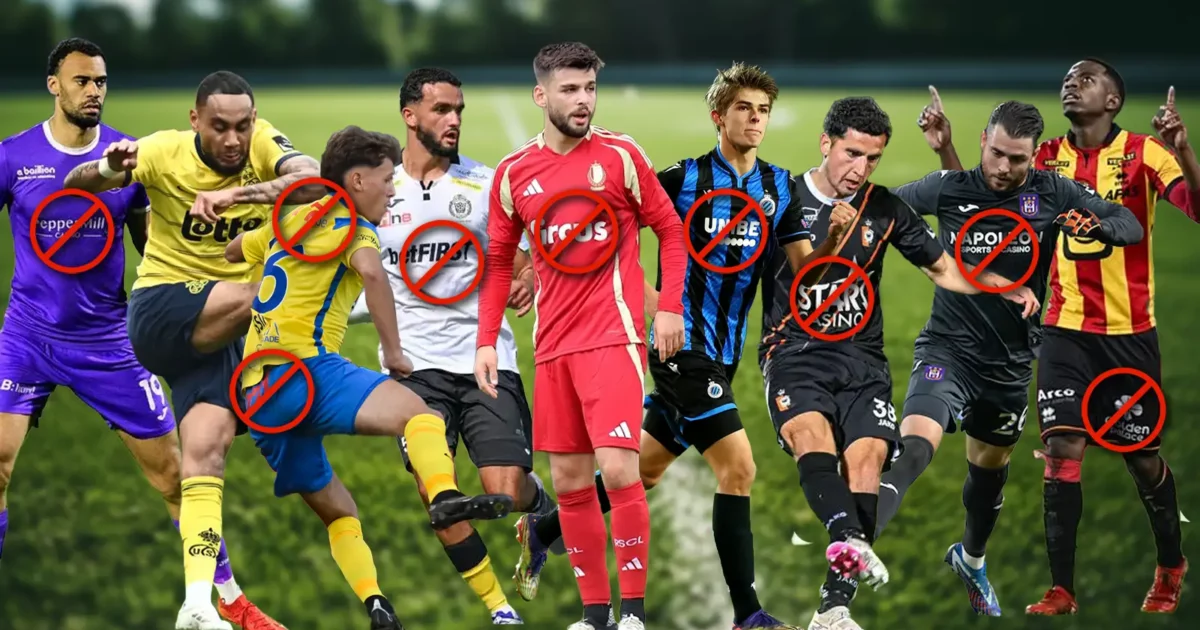
Sponsorship: casinos still present in the Jupiler Pro League
 •
2 Feb 2026 •
Reading time: 3 minutes
•
2 Feb 2026 •
Reading time: 3 minutes
Belgian professional football has always been driven by sponsorship deals. While the government is tightening the rules on gambling-related advertising, the links between clubs and industry players remain surprisingly strong.
A transformed legal framework but relationships intact
Since January 2025, Belgian legislation has changed the situation: gambling operators can no longer display their logos on the front of shirts, and advertising in stadiums or around pitches is strictly regulated. The authorities’ stated aim is to combat the negative social effects of gambling and reduce the public’s exposure to these brands.
Despite these restrictions, Belgium’s most prominent clubs continue to attract sponsors from the casino and sports betting worlds. To get around the bans, the strategies employed have become more subtle, and sometimes almost invisible to the uninformed fan.
A few examples
Club Brugge KV
Club Brugge KV, one of the giants of Belgian football, is an emblematic example of this transformation. In the past, Bruges’ shirts proudly bore the logo of Unibet, one of the biggest online betting operators. With the new laws that have come into force, this partnership has evolved: today it is BetFirst.sport, the Betsson group’s live statistics platform, that features on the front of the shirt.
RSC Anderlecht
At Anderlecht, another historic pillar of the Belgian league, the presence of gaming operators is also visible, but in an adapted form. The club has Sunweb on the front of its shirts for the current season, while Napoleon Score appears on the back, within the limits authorised by the regulations.
Standard de Liège
Standard de Liège has extended its partnership with Circus, the flagship brand of the Belgian Gaming1 group. The contract, renewed for three seasons, is reflected on the shirt through the Circus Daily logo, an information platform associated with the group.
Royal Antwerp FC
Royal Antwerp FC, which is enjoying a renaissance on the national and European scene, has had its own strategy for several years. An Antwerp First logo appears on the front of its shirts, reflecting a partnership with BetFirst to improve education, inclusion, the environment and health in Antwerp.
Cercle Brugge
At Cercle Brugge, the club sports Golden Palace News, a media outlet linked to the Golden Palace group, enabling the club to maintain a link with a major player in the gaming sector while complying with advertising restrictions.
Beyond the shirts: funding and economic survival
The use of these partnerships is not insignificant. For many clubs, revenue from television rights or ticket sales is no longer enough to cover the growing costs of modern football: salaries, infrastructure, recruitment, youth training and international competitions represent colossal expenses. Sponsorship contracts, however limited, remain a financial lifeline.
This dependence on sponsors linked to gambling is not without debate. Some sports and public health specialists are concerned about the social impact of such funding on the perception of gambling in society, while others point out that this income simply enables clubs to remain competitive.
Belgian clubs are currently faced with this duality. Despite a desire to comply with stricter rules, they are exploring ways of maintaining close links with players in the gaming sector.
Casino sponsorship is not dead: it has been transformed. Under the influence of strict new regulations, clubs have learned to rethink their commercial agreements. Yet these developments raise profound questions about the place of gambling in sport, the health of supporters and the ethics of partnerships.