




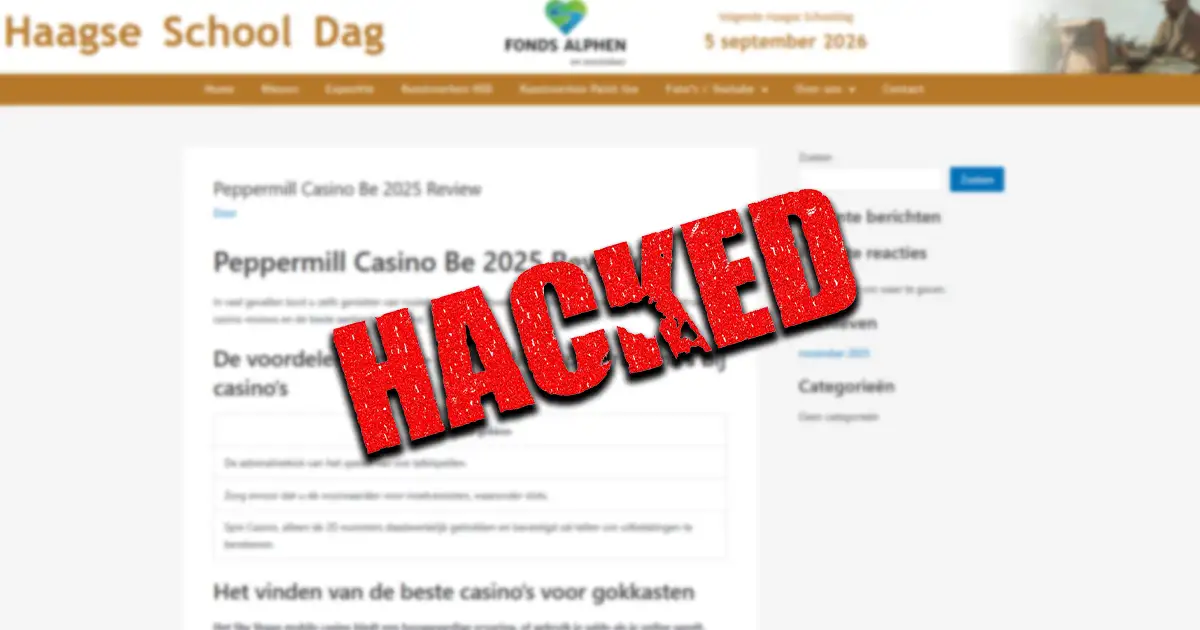
Illegal casinos: thousands of websites hijacked
 •
4 Sep 2026 •
Reading time: 4 minutes
•
4 Sep 2026 •
Reading time: 4 minutes
Websites with no connection to gambling are being used to lure Dutch players to illegal online casinos. According to a BNR investigation reported on 3 September 2026 by CasinoNieuws.nl, at least 1,000 domains and websites are believed to be affected. The actual number, however, could exceed 8,000.
Ordinary websites turned into gateways
At first glance, there is nothing to distinguish the websites in question from thousands of other pages on the internet. Some belong to companies, others to charities or various organisations whose activities have no connection with casinos. Yet pages dedicated to gambling appear on these domains and can then direct internet users to illegal online casino operators in the Netherlands. The owners of the sites in question are often unaware that their domain is being used to promote online casinos.
The phenomenon is growing on a considerable scale. According to a BNR investigation, at least 1,000 domain names and websites have been used in this way. Investigators estimate, however, that the actual number could be over 8,000.
The methods described in the investigation are based primarily on two mechanisms. In some cases, malicious individuals gain access to an existing website before adding new pages to it. In other situations, existing domain names are purchased and then reused to publish content related to gambling.
The search engine becomes a crucial link
Above all, this strategy enables unauthorised operators to bypass the usual advertising channels.
A web user searching for an online casino may thus come across a page hosted by a domain that, at first glance, appears perfectly legitimate. This page may then redirect them to an illegal operator.
The problem is exacerbated by the way search engines organise their results. Illegal casinos can capitalise on websites that have been online for a long time and thus attempt to boost the visibility of the pages used to promote them.
Illegal casinos seek alternative routes
Legal operators must comply with the rules governing gambling advertising. Unlicensed operators, on the other hand, seek alternative ways to gain visibility amongst Dutch players.
Website hijacking and domain takeovers are one such alternative method.
The situation becomes more complex when the domain owner is not themselves responsible for the promotional content. A compromised website may belong to an organisation that is not even aware that some of its pages link to illegal casinos.
The investigation thus highlights a challenge that goes beyond simply removing an advert. The promotional content may be scattered across a multitude of domains, whilst the pages acting as intermediaries may be hosted on infrastructure that initially has no connection to the gambling sector.
The Dutch regulator acknowledges the problem
The Kansspelautoriteit acknowledges the phenomenon described in the investigation. It is working with the foundation responsible for managing the Dutch national domain to combat .nl pages used for redirects. The Gaming Commission is doing the same with .be domains.
However, this process is often time-consuming.
One of the difficulties stems from the powers available to the regulator. The Ksa has no legal authority to block these sites directly.
Another limitation relates to domain name extensions. The relevant Dutch authority can take action on national .nl domains, but not on those using extensions such as .com or .eu.
The fight therefore does not depend on a single player. The Dutch regulator also explains that it depends in part on Google.
Google removes adverts, but not all results
Google removes adverts promoting illegal casinos. However, illegal gambling sites and intermediary pages used to redirect users are not systematically removed from search engine results.
When questioned by investigators, Google did not provide concrete answers to the various questions put to it. The company did, however, submit a written response in which it reiterated that it enforces a strict policy against techniques designed to manipulate the ranking of results.
Google states:
“Our automated systems work continuously to protect users from unwanted content, and when we discover sites that breach our rules, we take action.”
A battle over the visibility of legal and illegal offerings
Steven Vrolijk, from the KVA, took part in the BNR investigation. He describes the practices observed as particularly worrying.
In his view, the investigation shows that illegal operators are finding ever more ways to remain visible in the Netherlands. His analysis also raises a broader question about the restrictions imposed on the visibility of legal operators.
Vrolijk is calling for an independent impact assessment to be carried out before any new restrictions are introduced that would further reduce the visibility of legal content. His concern centres on a potential imbalance: authorised operators could become less visible whilst illegal operators continue to exploit various channels.
He summarises his concern as follows:
“If legal content continues to disappear from view whilst illegal operators remain highly visible through search engine listings, pirated websites, social media and other channels, it is difficult to predict the ultimate consequences for the safety of Dutch consumers.”