




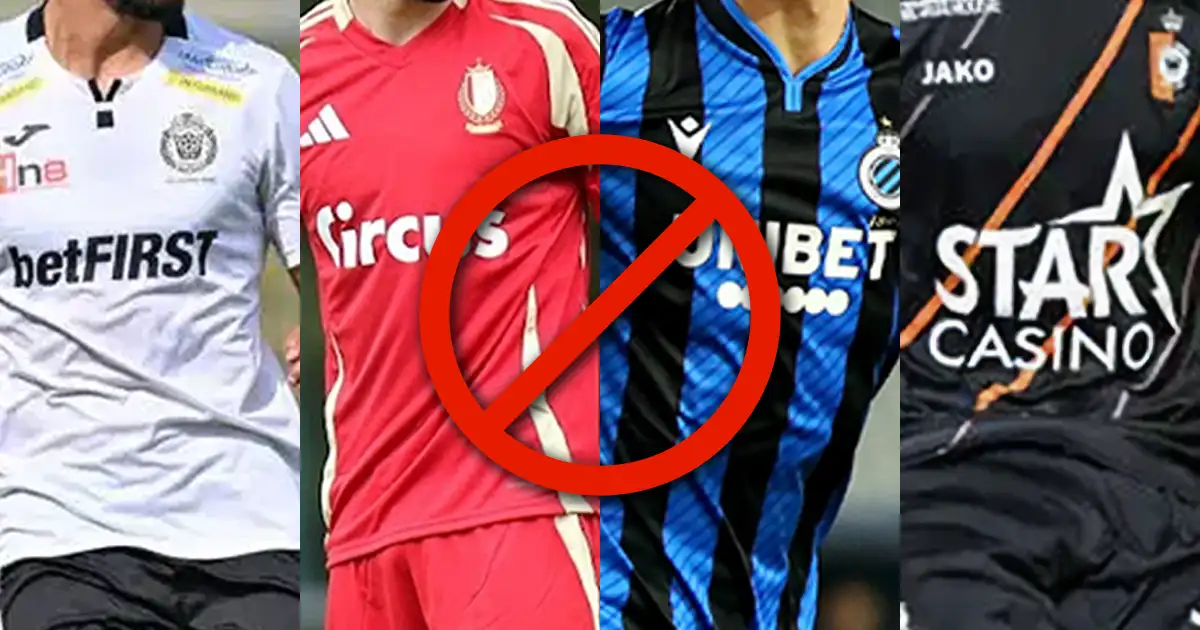
Verlinden accuses clubs of a lack of responsibility
 •
13 Aug 2026 •
Reading time: 4 minutes
•
13 Aug 2026 •
Reading time: 4 minutes
Justice Minister Annelies Verlinden has criticised the attitude of certain Belgian sports clubs in the face of stricter rules governing gambling advertising. Her department accuses them of failing to make sufficient use of the long transition period to seek new sources of funding and condemns their lack of social responsibility.
Alternative brands reignite the controversy
Operators such as Circus and Unibet run websites dedicated to news and sport. These alternative brands may then feature as part of sports partnerships. This situation allows these names to be visible in stadiums, even though direct advertising for gambling is prohibited there.
Annelies Verlinden’s office does not itself declare these practices to be illegal. It emphasises that this assessment falls within the remit of the Gaming Commission. It is up to the Commission to determine whether the use of alternative names in advertising constitutes a breach of the regulations.
The existence of a link between a sports media outlet and a company operating in the gambling sector is not, on the basis of the available evidence, sufficient to automatically establish a breach of the law. The question is whether the visibility gained under a different name amounts, in practice, to promoting the operator in question. The Gaming Commission would like to see the legislation amended in order to better combat what it considers to be disguised advertising.
The Minister for Justice is also targeting sports clubs
However, the reaction from the Minister’s office goes beyond the legal debate alone. Annelies Verlinden also directs criticism at sports clubs. These clubs have been granted a transition period before the end of shirt sponsorship by gambling operators. In the Minister’s view, this period should have been used to actively seek out other financial partners.
“It is particularly regrettable that sports clubs, amongst others, are not taking advantage of this very long transition period of four and a half years to seek out other sponsors,” states Annelies Verlinden’s office.
Advertising for gambling in stadiums is already banned. Another significant step will take place in 2028, when shirt sponsorship by gambling companies will also be banned.
Until then, this type of sponsorship remains possible, but only subject to strict conditions. The logo must not exceed 72 cm². Nor may it be placed on the front of the shirt.
These restrictions mark a gradual phasing out of the visibility granted to gambling operators in sport. The current period represents an interim phase during which certain partnerships remain permitted, but within a much more restrictive framework.
In the view of Annelies Verlinden’s consultancy, this transition should have encouraged clubs to plan for their future funding rather than seeking ways to retain, directly or indirectly, partners from the gambling sector.
“A lack of social responsibility”
The minister’s criticism is not limited to a question of compliance with the rules.
“All of this demonstrates a lack of social responsibility, particularly towards vulnerable groups at risk of gambling addiction,” her office states.
According to the minister’s reasoning, sports organisations must also take into account the consequences of the visibility granted to the gambling sector. The issue thus pits two realities against one another: the economic interests linked to sponsorship and the political will to limit the public’s exposure to gambling.
The minister’s office clearly believes that the lengthy transition period was intended to reconcile these two imperatives by giving clubs sufficient time to find new partners. However, strategies involving alternative brands give the minister the impression that this transition is not being used as intended.
Circus Daily rejects the suggestion of circumvention
In response to this criticism, Circus Daily takes a different stance. When asked about the nature of the website, its communications manager states that “Circus Daily was developed as a genuine sports media project”.
She also assures that the legislation is being complied with and rejects any suggestion of an attempt to circumvent the ban.
A professor of sports management speaks of a “cover”
However, not all observers share Circus Daily’s interpretation.
Bram Constandt, a professor of sports management at Ghent University, takes a much more critical view of these sites.
“This type of news site serves as a front, and we have been seeing this more and more blatantly since the ban on gambling advertising came into force,” he says.
The debate therefore no longer concerns only the presence of a logo explicitly associated with betting or games of chance. It also centres on brands whose visible activities may be media-related, but which remain linked to companies in the sector.
A battle over the spirit of the regulations
The four-and-a-half-year transition period was intended to give them time to turn to other sponsors. However, the continued existence of partnerships linked, directly or indirectly, to companies in the sector is now fuelling criticism.
For Annelies Verlinden, the responsibility of sports organisations certainly does not end with strict legal compliance. Her firm is calling on them to also take into account those who are vulnerable to the risk of gambling addiction.