



4.2 million online gamblers in France: who are they and what do they play?
 •
24 Nov 2026 •
Reading time: 7 minutes
France’s licensed online market for sports betting, horse race betting, and poker recorded roughly 4.2 million unique gamblers in 2025. That represents a 7.6 percent increase from a year earlier and the highest figure since 2019. Poker posted the strongest growth in active accounts, even as the number of players restricting themselves exclusively to poker declined. Meanwhile, more than one in five French 18- to 24-year-olds gambled with one of the surveyed operators.
These figures come from the socio-demographic analysis published by the Autorité nationale des jeux (ANJ) on November 17, 2026. The French regulator’s study examines three online gambling verticals across operators holding a French license. Online lotteries, land-based retail play, and unlicensed offerings fall outside the scope of the report. The 4.2 million figure therefore reflects the size of that specific regulated market segment.
One player can hold multiple active accounts
In total, the ANJ recorded 6.1 million active gambler accounts, up 7.1 percent. This works out to an average of 1.46 active accounts per unique player, virtually unchanged from 1.47 in 2024. Someone playing with two different operators may be counted twice in the account totals, whereas that same individual appears only once in the unique player count. Similarly, an account used for both poker and sports betting is counted in both verticals, yet only once in the overall market total.
Sports betting remained by far the largest category. Roughly 87.5 percent of unique players placed at least one sports wager in 2025, pushing active sports betting accounts past 5.2 million. This increase followed a year shaped by the UEFA European Championship and the Paris Olympic Games. Even with a lighter sporting calendar, player numbers continued to grow in 2025, sustaining the recovery after the downturn between 2021 and 2023.
Players and active accounts in France · figures × 1,000
| Category | 2023 | 2024 | 2025 | 2025 vs. 2024 |
| Sports betting | 4,324 | 4,882 | 5,267 | +7.9% |
| Poker | 1,913 | 2,115 | 2,465 | +16.5% |
| Horse race betting | 641 | 664 | 718 | +8.2% |
| Total active accounts | 5,126 | 5,698 | 6,100 | +7.1% |
| Total unique players | 3,582 | 3,874 | 4,169 | +7.6% |
Based on Table 1 of the ANJ report. The three verticals reflect active accounts; a single account may appear across multiple categories.
Poker growth is driven largely by people who also bet on sports
The number of active poker accounts rose from 2.12 million to 2.47 million, an increase of 16.5 percent. Since 2019, that figure has more than doubled. Looking at unique players provides deeper insight into this expansion: poker added a net 243,000 players in a single year, while the number of people playing poker exclusively fell by approximately 4,500. That group accounted for 13 percent of all poker players, down from 15 percent in 2024. Of all poker players, 85 percent also placed sports bets.
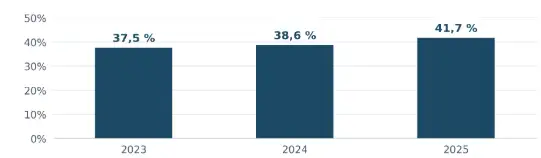
This fits into a broader shift. In 2023, 37.5 percent of all surveyed players were active in at least two verticals. That share rose to 38.6 percent in 2024 and reached 41.7 percent in 2025. Someone betting solely on sports across multiple operators counts under a single category, whereas someone betting on sports and playing poker with a single operator counts across two. That distinction is essential to understanding the growth: on average, players used roughly the same number of operators as a year earlier, while engaging across more verticals per account.
Share of players active in at least two gambling verticals
The ANJ points to cross-promotion as a possible explanation. An operator can, for instance, introduce someone already betting on football to its poker offering. While the data shows where players combine activities, further research is needed to determine which specific marketing actions drove this behavior. In our earlier coverage of the French sports betting prevention campaign, we explored why the regulator pays heightened attention during major sporting events to young players and warning signs such as chasing losses.
Financial data illustrates how a growing number of accounts can play out differently across verticals. In sports betting, average gross gaming revenue per active account rose 2.3 percent to €335. In poker, it dropped 8.6 percent to €213, and in horse race betting, it declined 5.3 percent to €454. These averages reflect operator revenue per vertical; how much an individual personally won or lost depends on their own playing habits and can vary substantially from the average.
More than one in five French young adults gamble online
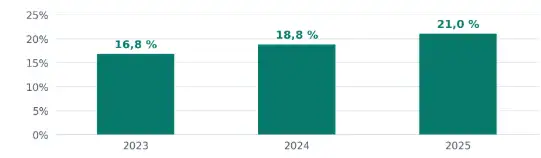
In 2023, 16.8 percent of all French 18- to 24-year-olds were active with the surveyed operators. A year later, that share stood at 18.8 percent, climbing to 21.0 percent in 2025. Sports betting accounts for a major portion of their participation: among all 18- to 24-year-olds, 20.3 percent bet on sports online, 9.4 percent played poker, and 1.0 percent wagered on horse racing. These figures overlap because a single young adult could be active in multiple categories.
Across all adult age groups combined, 7.5 percent were active in the surveyed online market—making participation among 18- to 24-year-olds nearly three times the adult average. Their share within the overall player base is expanding as well: in 2025, this age group represented 28.4 percent of unique players, up 1.1 percentage points from the previous year. Alongside the report’s release, the ANJ noted that the French law of August 3, 2026 tightens rules around raising previously set gambling limits for players aged 18 to 25.
Share of online gamblers among French 18- to 24-year-olds
The number of female poker players is rising rapidly
The French regulator recorded roughly 703,000 female players, accounting for 16.9 percent of all unique players compared to 16.2 percent in 2024. The number of women grew by 11.6 percent year-on-year, versus 6.9 percent among men. Among women aged 18 to 24, player numbers jumped by 19.4 percent.
Poker saw the widest growth gap between men and women: female poker players increased by 21.7 percent, compared to 14.1 percent for male poker players. In horse race betting, both groups grew at roughly the same pace, though women accounted for a higher share at 20.1 percent than in the other verticals. The fastest growth in female participation and the highest proportion of female players therefore occur in different segments of the market.
Why the geographic map differs by game
Participation across the three online verticals in mainland France and Corsica ranged from 4.0 percent of adult residents in Creuse to 9.7 percent in Pas-de-Calais. Age demographics explain part of these regional differences: where relatively large numbers of young adults live, sports betting participation tends to be higher. Once the ANJ adjusts for those age disparities, Corsica, Hauts-de-France, and Provence-Alpes-Côte d’Azur stand out clearly above expected levels for both sports betting and poker.
The map for horse race betting follows a different pattern. The ANJ observes higher participation along an arc stretching from Pays de la Loire through Normandy to Hauts-de-France, reaching 2.8 percent of adults in the Mayenne department. That region has a high concentration of horse breeding farms, training centers, and racetracks—illustrating how a national ranking by game category can mask local dynamics. Moreover, among French residents aged 55 and over, horse race betting ranks ahead of poker, while sports betting remains the most popular of the three across those age brackets as well.
In Belgium, player numbers on licensed sites declined
Belgium’s Gaming Commission reported a contrasting trend for the same year. In 2025, 528,706 people played at least once with a licensed online operator, down from 602,288 in 2024. Newly registered online players fell from 193,342 to 110,032. At the same time, the average number of daily active players rose from 155,643 to 160,144, according to figures from the Belgian Gaming Commission’s 2025 annual report. Annual and daily counts reveal different realities: the former measures reach over an entire year, while the latter captures how many people play on a typical day.
Since September 1, 2024, a minimum legal age of 21 applies in Belgium to games of chance and betting supervised by the Gaming Commission. In our interview on Belgian gambling legislation with Magali Clavie, the Gaming Commission’s chairwoman also explains why casino games and betting are hosted on separate websites—a structure that differs from the French market, where players more frequently try a second vertical with their existing operator. Furthermore, Belgium’s annual report includes licensed online casino games, whereas the ANJ analysis covers only sports betting, horse race betting, and poker.
Data sources also make a key difference. Our article on the Belgian survey of 18- to 20-year-olds reflects self-reported behavior, including gambling outside the licensed market, whereas the French figures stem directly from account activity at licensed operators. When examining who gambles online, legal age thresholds, the verticals tracked by the regulator, and whether figures come from actual account activity or surveys all shape the picture.