





Belgium losing online gamblers offshore: ‘drops to European average’
 •
8 Jul 2026 •
Reading time: 7 minutes
•
8 Jul 2026 •
Reading time: 7 minutes
Belgium is becoming less successful at keeping online gamblers within the licensed circuit.
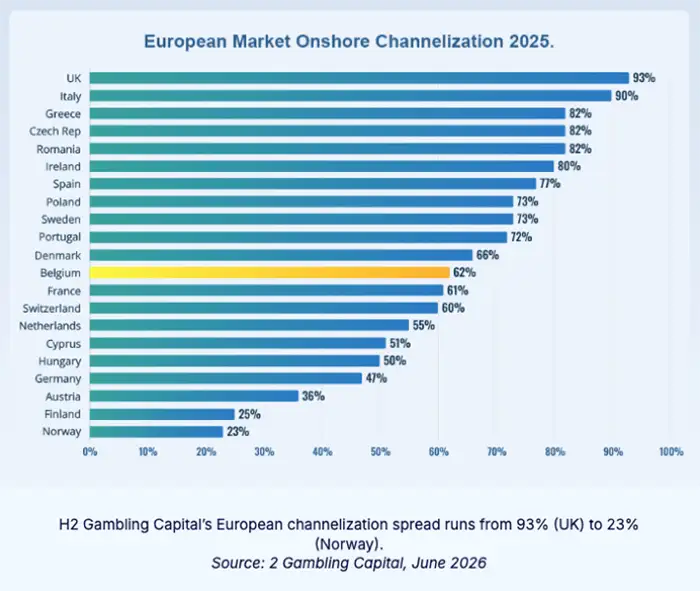
New figures from H2 Gambling Capital show that only 62% of the Belgian online gambling market still goes through locally licensed operators. This places Belgium not at the very bottom, but far from the European top.
This figure is crucial. It means that nearly four out of ten online gamblers, or at least a significant portion of their bankroll, end up outside the regulated Belgian offer. For a market that relies heavily on consumer protection, advertising restrictions, and strict licensing requirements, this is an uncomfortable finding.
Across Europe, the differences vary widely. According to H2, the United Kingdom achieves a channelisation rate of 93%, Italy 90%, and countries like Greece, the Czech Republic, and Romania stand at 82%. With its 62%, Belgium sits in the middle of the pack, just above France at 61%, Switzerland at 60%, and the Netherlands at 55%.
The Belgian player is not disappearing, but shifting
The figures do not indicate that Belgians are gambling less. They primarily show that a portion of players is shifting to offshore operators. These are websites without a Belgian license, often based outside the European Union or operating through structures that are difficult to monitor.
For policymakers, this is a tricky problem. The stricter the rules become for legal operators, the wider the gap can grow with the illegal market. Licensed casinos must comply with limits, advertising restrictions, identity checks, responsible gaming procedures, and tax obligations. Illegal operators do not have to, or simply claim to be out of reach of the Belgian regulator.
This creates an uneven playing field. The legal market becomes safer, but sometimes also less attractive. The illegal market becomes riskier, but often offers higher bonuses, more promotions, faster registration, and a wider selection of games.
Bonuses and game selection draw players offshore
The H2 data reveals that players migrate to illegal operators mainly for commercial reasons. In the Dutch section of the study, players cited better bonuses, a better game selection, and better odds as their primary reasons. In contrast, identity checks and cryptocurrency options ranked lower on the list.
This conclusion is highly relevant for Belgium. Here too, the debate often focuses on stricter rules, less advertising, and more restrictions. However, if the legal offer becomes too weak as a result, the effect can be counterproductive. Players do not automatically stop gambling; they simply look for an alternative.
This is precisely the risk that many operators have been warning about for a long time. A regulated market only works when players have a reason to stay there. Trust, safety, and licenses are important, but they do not always win against better bonuses or a wider selection.
Gaming1 sees personalisation as the answer to offshore competition
In this context, Gaming1’s vision becomes interesting. CTO Christophe Boniver argues that the future of online gambling is not about simply offering more games. According to him, operators need to understand players better and provide a more personalised experience.
Gaming1 aims to stand out with its own technology, AI, and data. Because the company manages its own platform, it is less dependent on third-party suppliers. According to Boniver, this allows for greater control over product development, personalisation, and responsible gaming.
For Belgium, this is not a minor detail. If only 62% of the market remains within the legal circuit, licensed operators must compete harder on experience. Not by irresponsibly giving out more bonuses, but by becoming more relevant, faster, and more personal.
Proprietary technology becomes a strategic weapon
Boniver calls Gaming1’s proprietary platform one of its most important strategic advantages. Many operators use third-party technology, which makes them dependent on external developers, standard solutions, and waiting lines for new features.
Gaming1 chooses a different path. By building the technology itself, the company can react faster to what players do and expect. This is vital in a market where players have grown accustomed to digital platforms that respond instantly to their behavior.
Netflix, Spotify, and social media have changed the standard. Users expect digital products to understand their preferences. Online casinos often lag behind in this regard. Many platforms still display the same lobby, the same promotions, and the same communication to large groups of players.
According to Boniver, this is precisely where the opportunity lies. Those who understand players better can make the legal offer more attractive without weakening player protection.
AI must not just sell, but also protect
An important component of Gaming1’s strategy is AI. However, Boniver does not see AI solely as a tool to generate more revenue. He emphasizes that the same technology must also be used for responsible gaming.
This is crucial for Belgium. The Belgian market is under political and social pressure. Gambling is increasingly discussed from the perspective of addiction risks, youth protection, and advertising restrictions. Operators who only talk about personalisation for commercial growth risk losing trust.
Gaming1 tries to position this differently. AI can show players personalised offers, but it can also recognize signals when playing behavior changes. Think of more frequent deposits, longer playing sessions, chasing losses faster, or behavior that deviates from a player’s normal profile.
When these signals are picked up early, a platform can intervene in a more targeted way. Not with generic warnings that everyone ignores, but with personal insights and concrete actions.
Belgium must remain both attractive and safe
The Belgian challenge is therefore twofold. The legal market must remain safe, but also attractive enough not to push players away. A channelisation rate of 62% shows that this balance is under pressure.
If the government focuses primarily on restrictions, the risk arises that legal operators will become increasingly unable to compete. On paper, this looks strict and protective, but in practice, it can drive players toward sites where no protection exists at all.
The H2 figures show that this is no longer a theoretical discussion. In Europe, markets with a competitive legal offer clearly perform better. Countries with heavy restrictions frequently rank lower. Belgium sits right in the middle: not dramatically low, but not reassuringly high either.
The battle is over trust, convenience, and relevance
A license alone is not enough. Players must also recognize, trust, and want to use the legal offer. According to the H2 data, reputation plays a major role in choosing an operator. However, reputation only works when the product itself remains strong enough.
For Belgian operators, this means they must invest in user friendliness, faster payments, better customer service, relevant promotions, and a clear responsible gaming policy. The player must feel that the legal operator is not only safer, but also simply better.
That is the core of Boniver’s story. Gaming1 does not want to compete by simply putting more content on the platform. It wants to use technology to make the experience smarter. Less generic, more personal.
Crypto casinos increase the pressure
An additional threat comes from crypto casinos. According to H2, web traffic to major crypto casinos in five Northern European markets grew from 10 million visits in 2021 to 128 million in 2024. The share of crypto casinos within offshore traffic rose from 2% to 25% during that period.
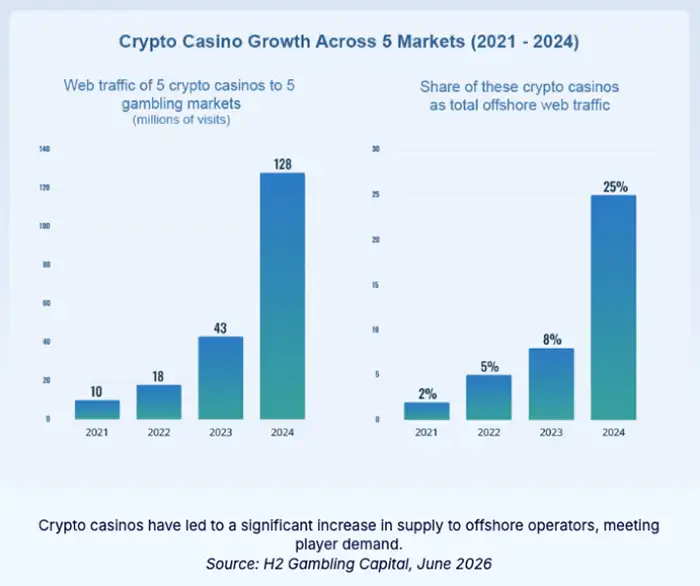
This is also relevant for Belgium. Crypto casinos are often harder to block, change domains quickly, and target aggressively players who want less friction. They offer fast registration, crypto payments, and huge bonuses.
For regulators, this is a nightmare. For legal operators, it is a commercial threat. And for players, the risk is immense because protection, complaint procedures, and oversight are usually completely absent.
The Belgian market has received a clear signal
The 62% is therefore more than a statistic. It is a warning. Belgium still keeps a majority of players within the regulated offer, but the margin of safety is not comfortable.
If nearly 40% ends up outside the licensed circuit, the government loses its grip. Not just on tax revenues, but primarily on consumer protection. Players who gamble offshore fall outside the systems that are specifically designed to prevent problematic gambling behavior.
This makes the discussion around technology, AI, and personalisation more urgent. Not as a luxury project for large operators, but as a necessary step to keep the legal market relevant.
Belgium must make the legal market attractive again
Gaming1’s message fits into a broader European discussion. The future of online gambling is not determined solely by stricter rules, but by whether licensed operators can provide an experience that convinces players to remain within the legal circuit.
For Belgium, this question is acute. With a channelisation rate of 62%, it is clear that a significant part of the market is leaking away. The solution does not lie in a single measure, but in a better balance between protection and attractiveness.
Operators must invest in technology, data, personalisation, and responsible gaming. Regulators must simultaneously realize that an overly restricted legal offer does not automatically protect players. It can instead send them to places where no one is watching.
Belgium still has a strong regulated foundation. However, the figures show that this foundation is under pressure. The coming years will show whether Belgian license holders, technology companies, and policymakers can keep the legal market attractive enough to push back offshore competition.